
We work internationally with:
- Parents seeking evidence-based guidance and psychological support
- Parents of children aged 0–12
- Parents of adolescents aged 13–17
- Families experiencing emotional or behavioural challenges
- Corporate Global Teams wanting to improve working climate and boost productivity
International Expertise in Child and Family Psychology
Led by a Chartered Psychologist with more than two decades of experience across psychological practice, higher education, and international research, The Emotional Development Centre combines scientific expertise with emotionally accessible care.
Our work draws upon the latest scientific findings of research around:
- Cognitive Neuroscience
- Developmental Psychology
- Child and Adolescent Mental Health
- Socio-Emotional Development
- Parenting Psychology
- Behavioural and Emotional Regulation
- School and Life Transitions
- Emotional Intelligence
Professional affiliations and experience include:
- Chartered Psychologist (BPS)
- Senior Fellow of Advance HE (SFHEA)
- Member of the American Psychological Association (APA)
- Member of the European Early Childhood Education Research Association (EECERA)
- International research and teaching experience across multiple continents
- Extensive experience supporting families, students, educators, global teams and corporate organisations
What is Emotional Development (ED)?
Why should parents know about ED in their Children and Adolescents?
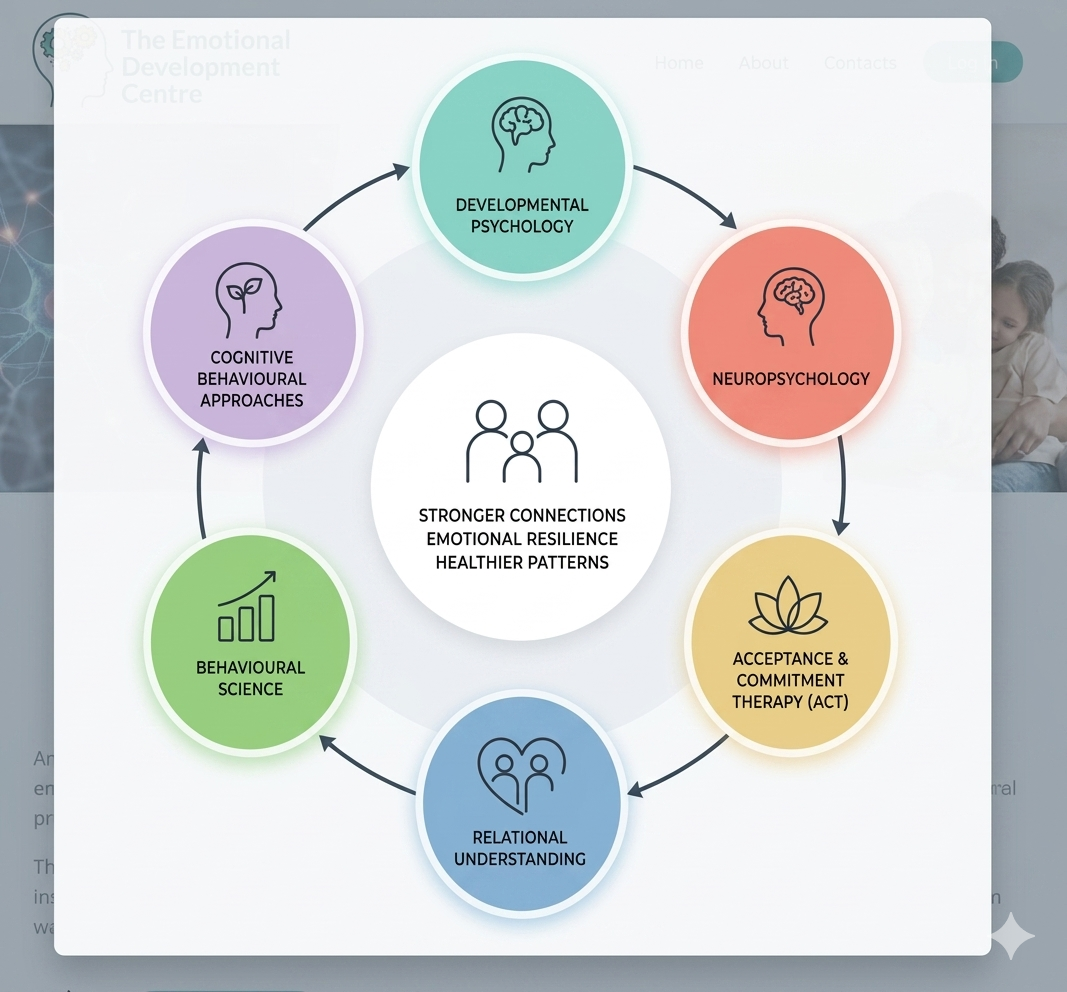
Our Evidence-Based Model of Emotional Development
Emotional development follows two critical phases. Foundational Years (0–12): children learn to recognise and express emotions through secure attachments with caregivers. Transition Years (13–17): adolescents experience heightened brain reactivity and reorganise their identity — often amplified by social media.
Our model uses empirical research to inform everyday parenting.
We use the latest findings in neuropsychology to help you regulate emotions, navigate transitions, and build resilience.
No guesswork. Just evidence-based strategies for a happier family and more productive global teams.
Scientific Support and References
Carpendale, E. J., Green, M. J., White, S. L. J., Williams, K. E., Tzoumakis, S., Watkeys, O. J., Harris, F., O'Hare, K., Carr, V. J., & Laurens, K. R. (2025). Promoting effective transitions: Primary school social-emotional competencies predict secondary school reading and numeracy achievement. British Journal of Educational Psychology, 95(2), 496–512.
Duman, H., & Yılmaz, T. (2026). The mediating effect of cyber victimization and cyberbullying on the relationship between social media addiction and emotional and psychological well-being in adolescents. BMC Psychology, 14, 355.
Elvira-Zorzo, M. N., & Bayona Gómez, P. (2025). Identity construction and digital vulnerability in adolescents: Psychosocial implications and implications for social work. Youth, 5(4), 119.
Frontiers. (2026). Emotional, moral, and social development from birth to adolescence: Advances in mechanisms, contexts, and trajectories [Research Topic].
Ibrahim, M. (Ed.). (2025). Emotional regulation: Theory and application across clinical settings. IntechOpen.
Isdahl-Troye, A., Villar, P., Álvarez-Voces, M., & Romero, E. (2025). Unraveling the dynamics of emotional regulation and parental warmth across early childhood: Prediction of later behavioral problems. Scientific Reports, 15, Article 23294.
Jónsdóttir, L. K., Frick, M. A., Frick, A., Heeman, E. J., & Brocki, K. C. (2026). Examining early inhibitory control and emotion regulation as predictors of childhood internalizing and externalizing problems: A longitudinal study. JCPP Advances, e70093.
LoBue, V., et al. (2022). How the emotional environment shapes the emotional life of the child. Policy Insights from the Behavioral and Brain Sciences, 9(1), 137–144.
Griffith, J. M., et al. (2021). Affective development from middle childhood to late adolescence: Trajectories of mean-level change in negative and positive affect. Journal of Youth and Adolescence, 50(8), 1550–1563.
Sánchez-Álvarez, N., Extremera, N., & Rey, L. (2025). Adolescent social media use and emotional intelligence: A systematic review. Adolescent Research Review, 10, 201–218.
Stuber, F., Seifried-Düben, T., Rieger, M. A., Gündel, H., Ruhle, S., Zipfel, S., & Junne, F. (2021). The effectiveness of health-oriented leadership interventions for the improvement of mental health of employees in the health care sector: a systematic review. International Archives of Occupational and Environmental Health, 94(2), 203–220.
*Disclaimer: All information related to summaries of scientific research are paraphrased summaries of the original research. No text has been copied verbatim. For full details, please refer to the original publications.